A conference by W.I.P Labs · Ahmedabad 2026 · Next edition 2027
Listening Otherwise
India's first international, practice-led conference on improvised and experimental music. Talks in the morning, open rehearsals in the afternoon, performance at night.
- First edition
- February 2026
- Venues
- CEPT University and Kanoria Centre for Arts, Ahmedabad
- Resident ensemble
- Dilli Improvisers Orchestra
- Next edition
- 2027, dates to be announced
About the conference
Listening Otherwise is India's first international conference on improvised and experimental music. It was conceived and produced by W.I.P Labs, and the first edition was held across CEPT University and the Kanoria Centre for Arts in Ahmedabad in February 2026.
Most international gatherings on experimental music are held in Berlin, New York, London or Amsterdam. That choice is never neutral. It decides who can afford to attend, which institutions are treated as the natural hosts, and whose cultural context frames the whole event. Holding this conference in Ahmedabad was a deliberate refusal of that default. It put the burden of travel, and of working in an unfamiliar context, on the international participants rather than on the Indian ones.
Those moments were the bedrock of the work we did.
Listening otherwise
There is a question that surfaces sooner or later for any non-Western practitioner working in experimental music: whose ears are the reference point? When we talk about deep listening, about full attentiveness to a sonic environment, whose model of careful listening are we drawing on?
Listening otherwise is the phrase the conference was built around. At its simplest it means bringing a different set of assumptions to the act of sonic attention. Every trained listener arrives at a performance carrying expectations about what counts as musical coherence, where authority should sit, and which sounds are music and which are noise. Those expectations are not natural. They are the residue of specific traditions and specific histories of inclusion and exclusion, which means they can be questioned, suspended and replaced.
It works at three levels at once. As a critical practice, it means asking not only whether something is good but good according to whose model of coherence. As a generative practice, it means attending to traditions that are not your own in a spirit of real openness rather than documentation or extraction. And as a social and teaching practice, it means organising the rooms in which sound is heard and discussed so that non-dominant traditions arrive as producers of ideas rather than as examples of difference.
Why Ahmedabad
Ahmedabad is a city shaped by craft, textile and musical traditions going back centuries, by the political legacy of Gandhi and the independence movement, and by one of the most significant concentrations of modernist architecture in Asia.
It also has a history that is only now being recovered. In 1969 the National Institute of Design in Ahmedabad became the site of India's first electronic music studio, when David Tudor, pianist and the closest creative collaborator of John Cage, arrived with a new Moog modular synthesiser shipped in wooden crates from New York. Gita Sarabhai, whose family co-founded NID, had studied with Cage in New York and had taught him about Indian music in return.
The composers who used that studio, among them Gita Sarabhai, Atul Desai, I.S. Mathur, S.C. Sharma and the then nineteen-year-old Jinraj Joshipura, made what is now recognised as India's first body of electronic music. The tapes sat in the NID archive for nearly fifty years until they were rediscovered and documented by the artist Paul Purgas.
Jinraj Joshipura was in the room at Listening Otherwise. He is the only surviving member of that group. During Jay Kreimer's instrument-building workshop, Joshipura crossed the room to shake his hand, and it emerged that the David Tudor ideas Kreimer had carried into Ahmedabad had in part been formed in Ahmedabad.
How the days were built
Three days that turned the usual academic conference around. At most music conferences the papers are the event and the performances are extras. Here the afternoon rehearsal was not an illustration of the morning's ideas; it was an argument in its own right.
- MorningsTalks and workshops
- Sessions on collective improvisation, ensemble ethics, and listening as a political and historical practice rather than a purely technical one.
- Indian musical vocabulary held as concepts to think with. In one session, participants described a moment of musical tension and its resolution: those trained in Western traditions reached for harmonic language, those familiar with Indian classical traditions reached for rasa. Each framework named what the other could not.
- Jinraj Joshipura on the 1969 NID studio, and on what has been lost and recovered in the fifty years since.
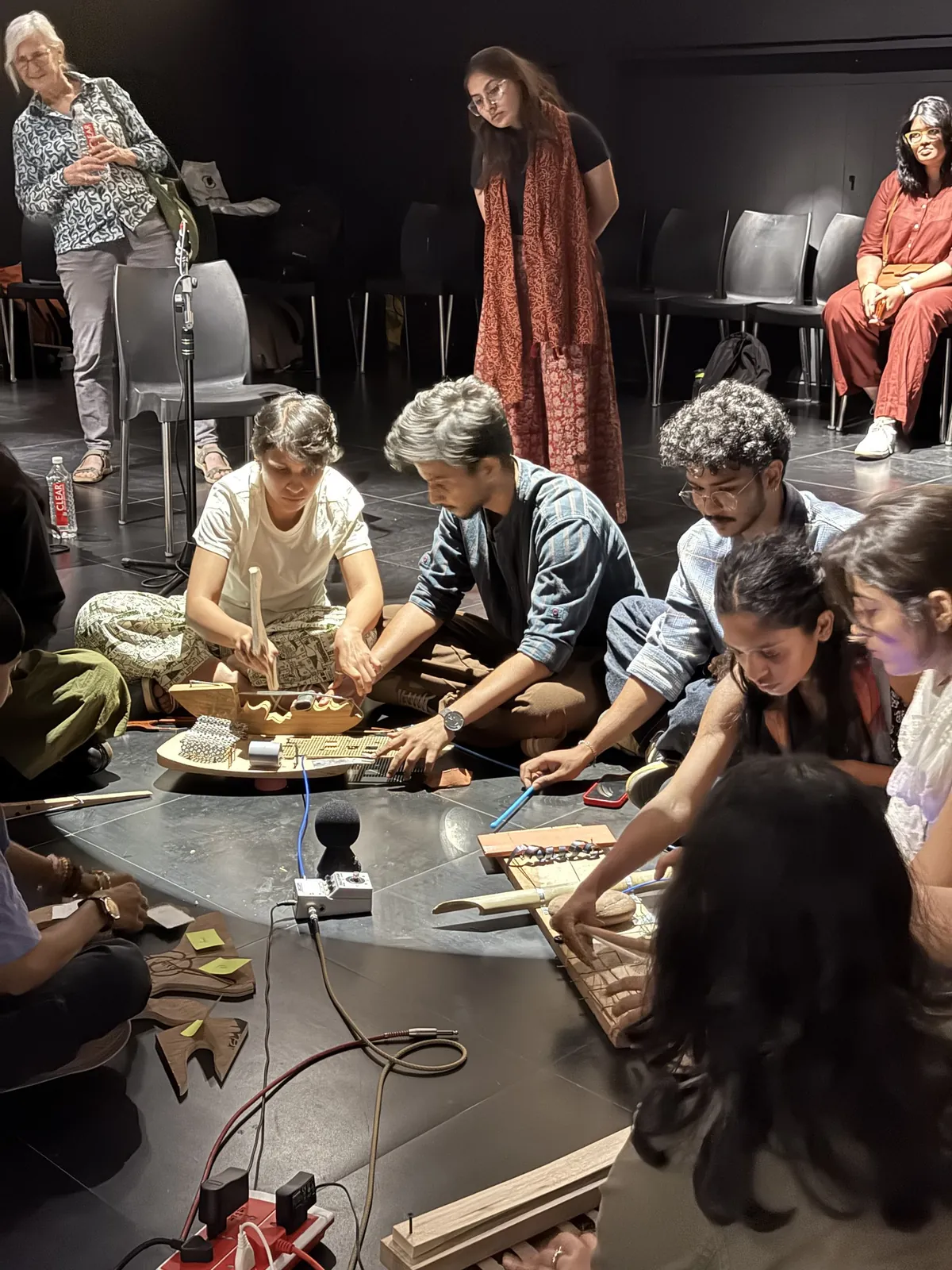
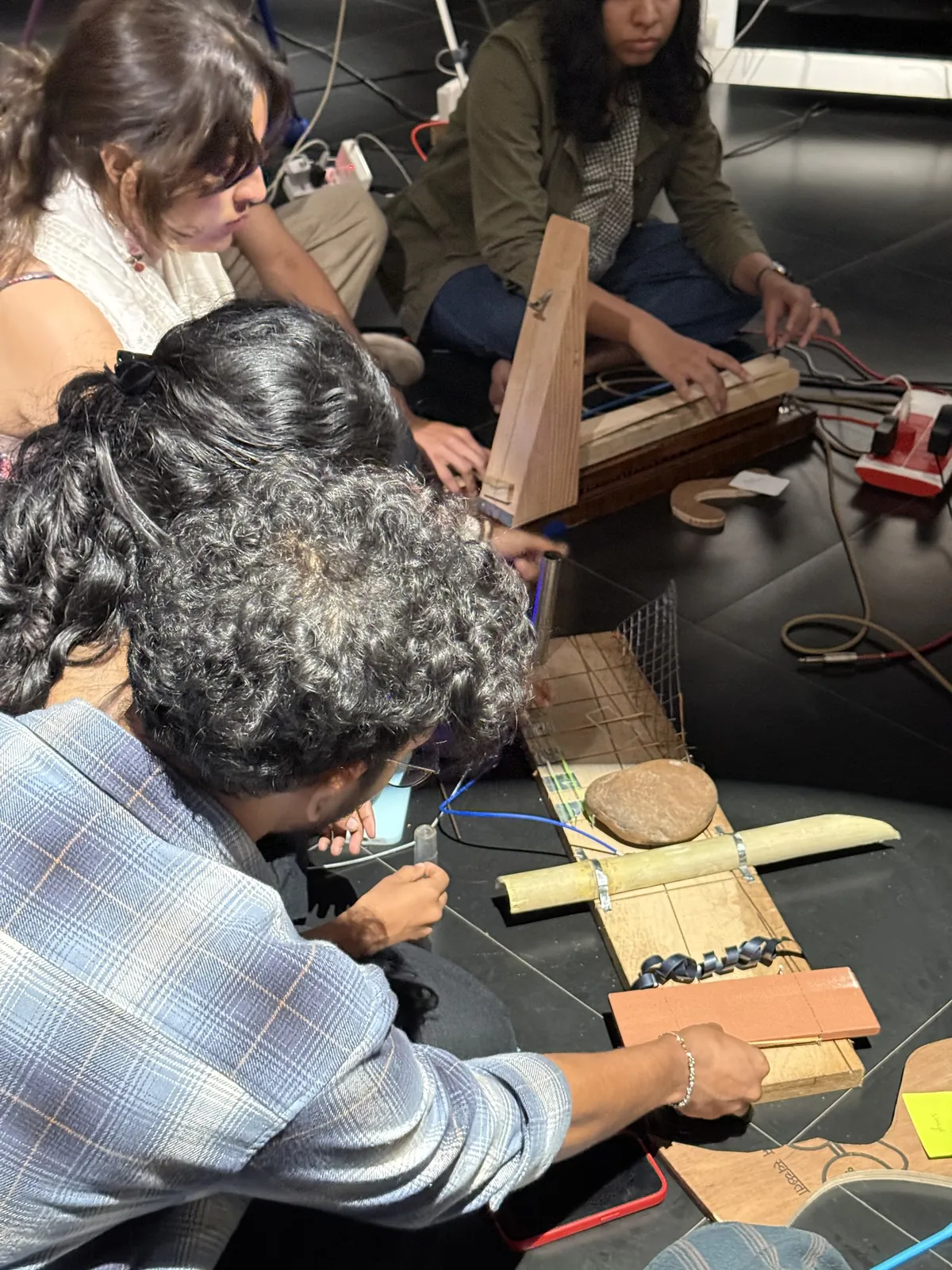
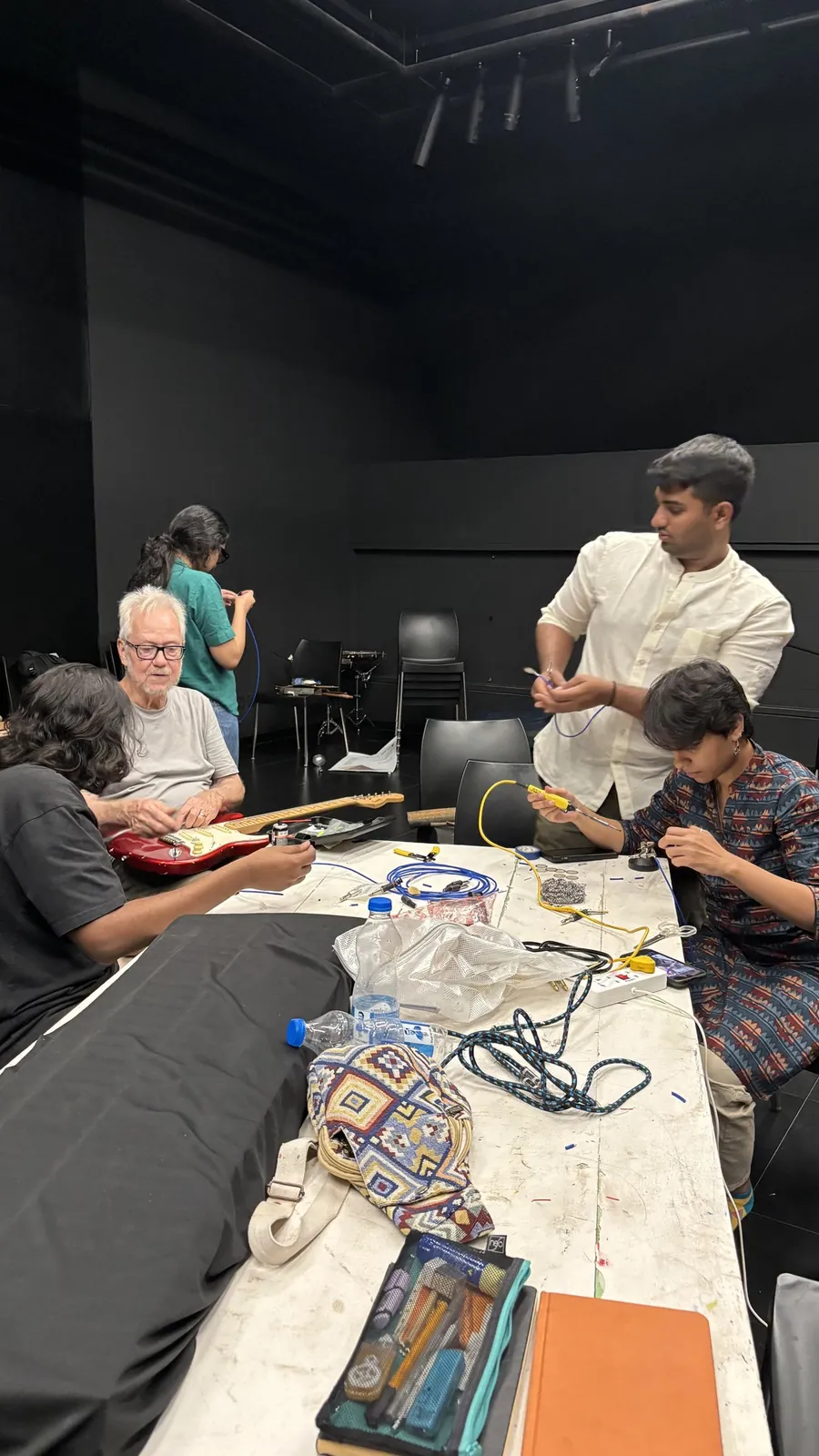
- Jay Kreimer's instrument-building workshop with the Critical Sound Design studio at CEPT: minimal instruction, maximal experimentation. Students built working instruments from scrap wood, split bamboo, punched steel sheet, springs and found objects, amplified with piezo pickups. One stayed up all night finishing an instrument in what Kreimer called a brain fever. They named themselves the Brains on Fire Orchestra.
- AfternoonsOpen rehearsal
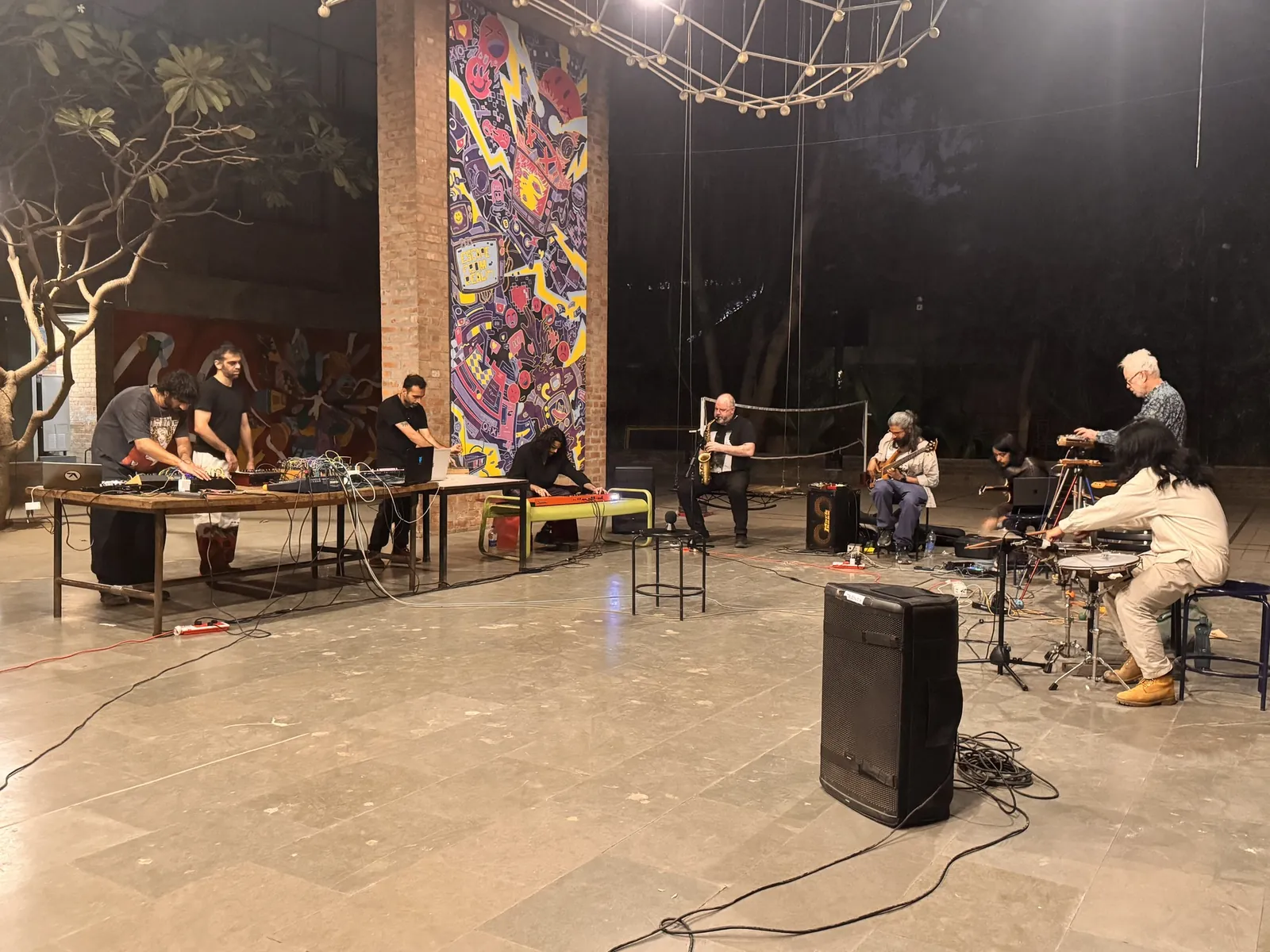
- The Dilli Improvisers Orchestra rehearsed in a large studio with the ensemble in the centre and observers seated around it. No stage, no audience area, no programme note explaining what to listen for.
- The musicians worked through free improvisation, graphic scores and conduction without pausing to explain.
- Each session closed with thirty minutes of discussion open to everyone in the room, so the line between musician and witness was dissolved on purpose.
- EveningsPerformance
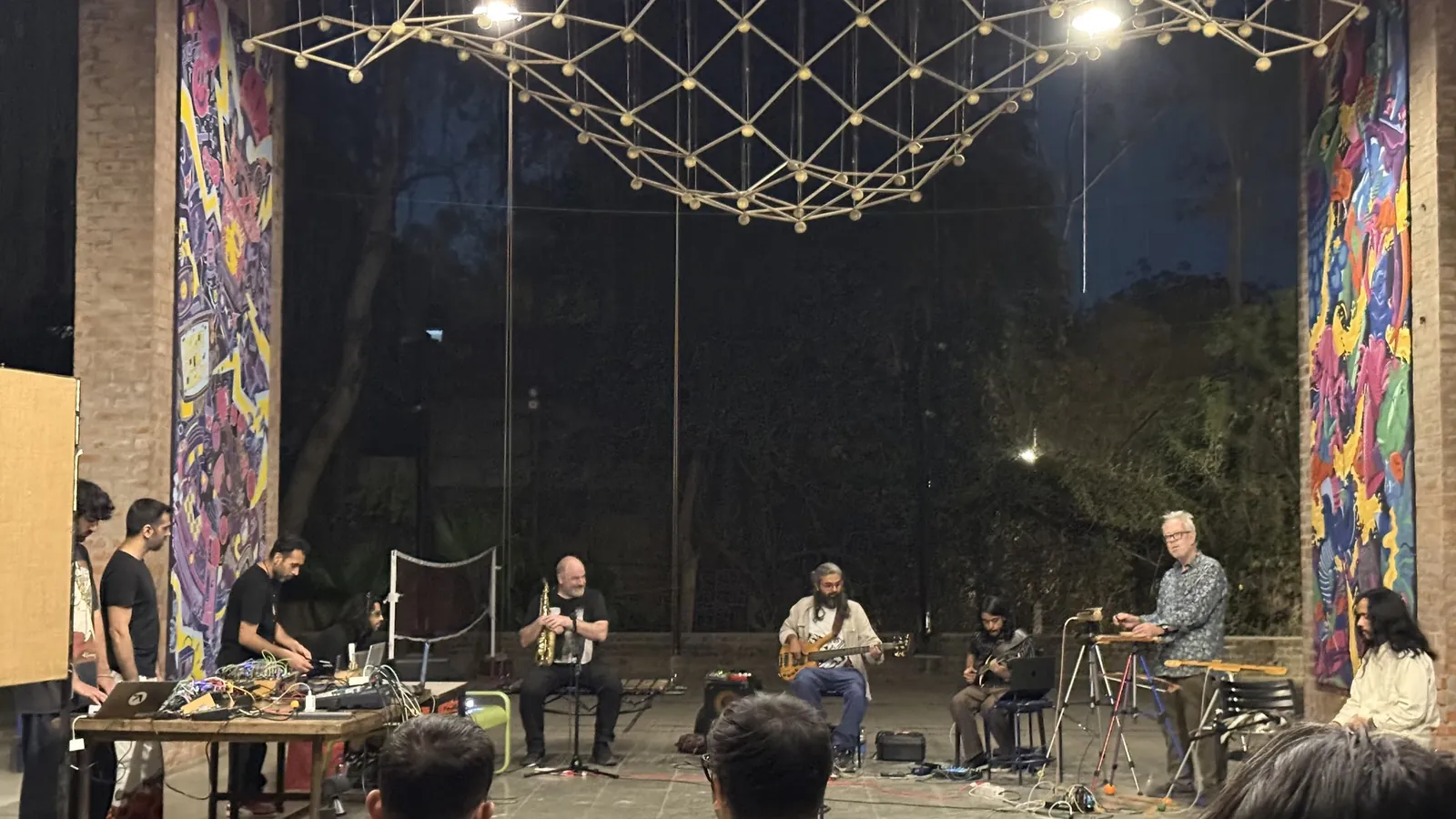
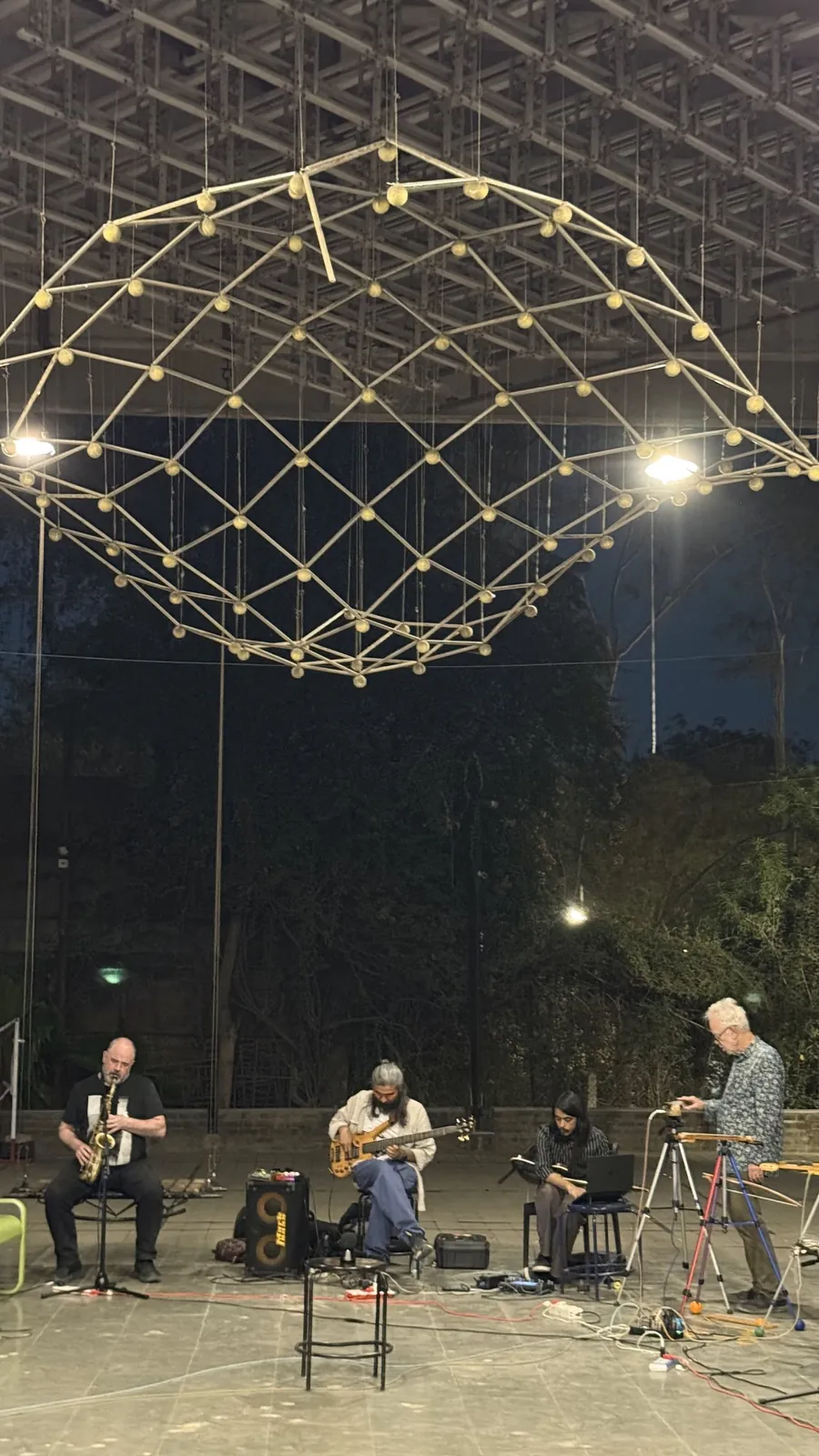
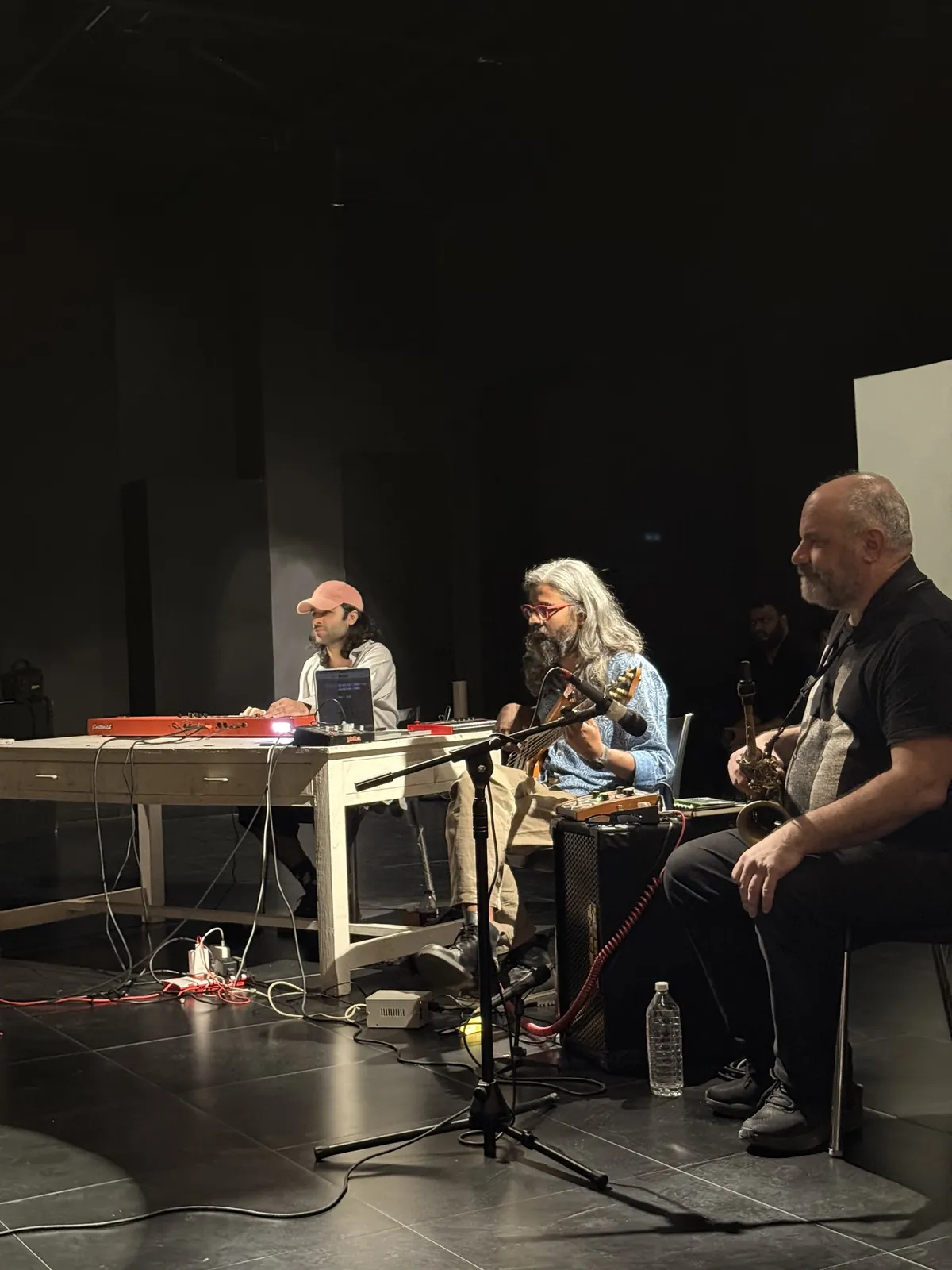
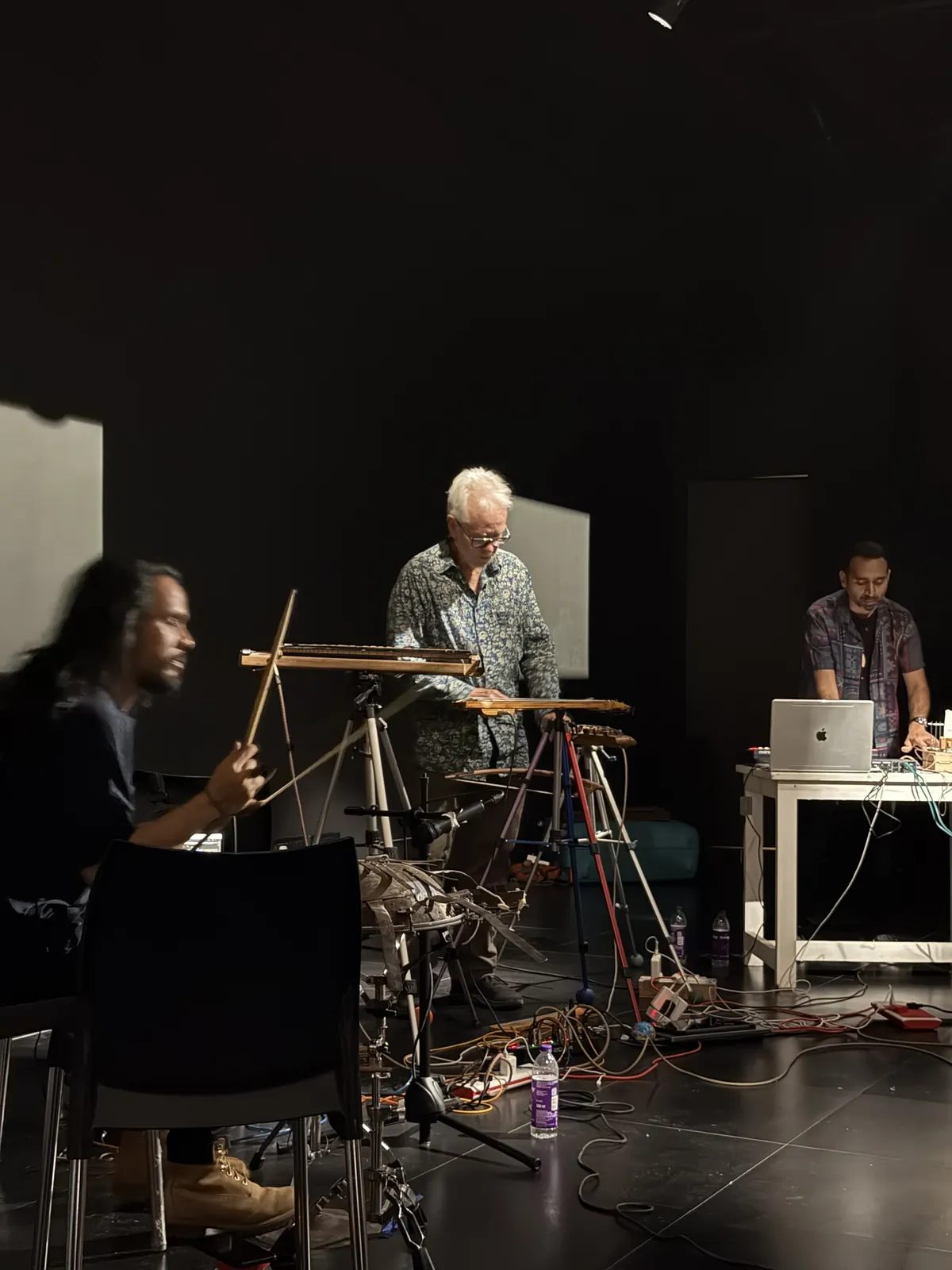
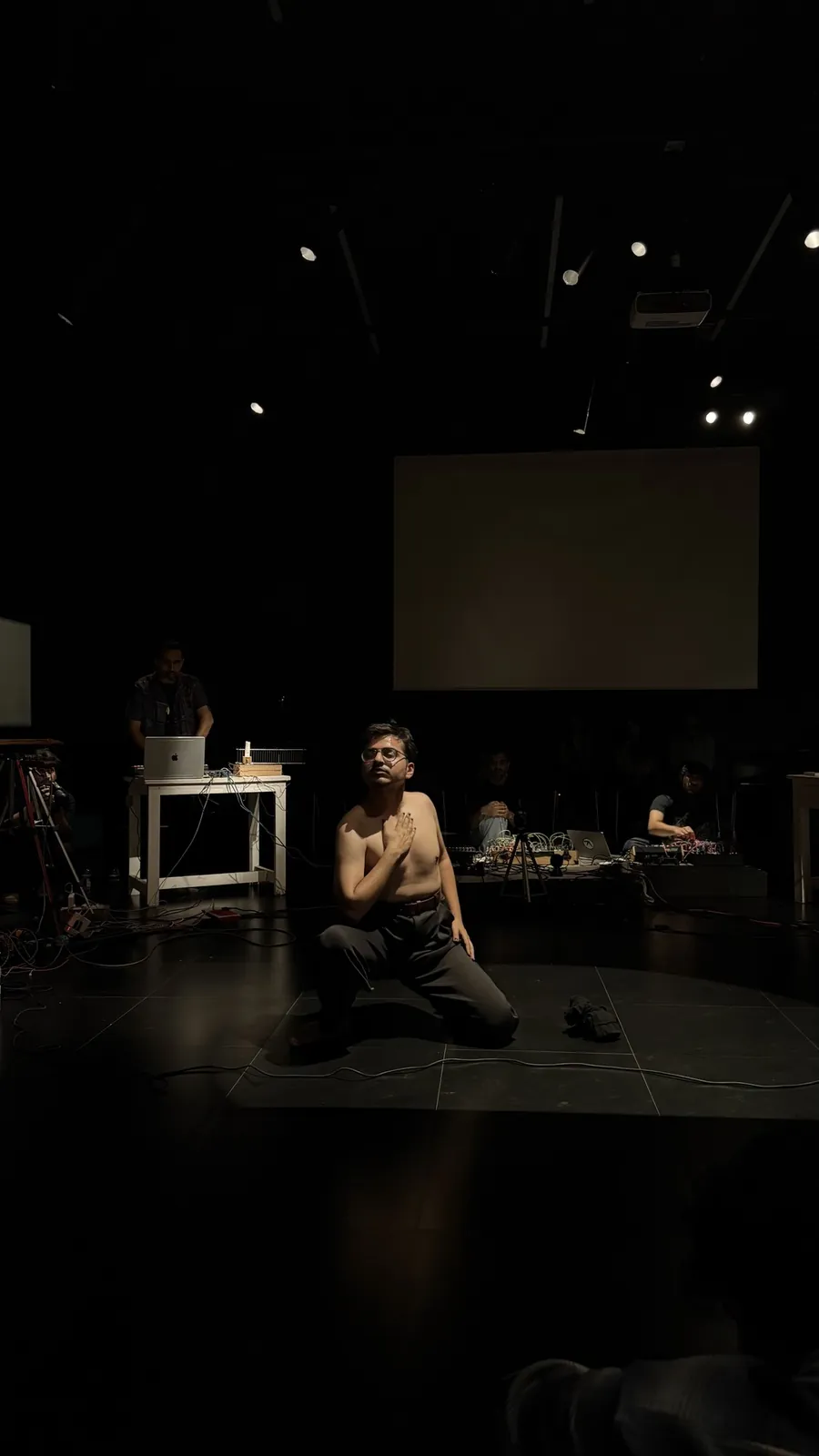
- Dilli Improvisers Orchestra, with Raymond MacDonald on saxophone and conduction.
- Jay Kreimer on invented instruments, including his graphic score "It came in through the window," written for Pauline Oliveros.
- Aldo Ahmad, percussion.
- Brains on Fire Orchestra, Friday evening at the Kanoria Centre for Arts, on the instruments they had built.
- Mixed large-ensemble sets bringing international and Indian musicians together with students.
Photographs
Participants
Raymond MacDonald
Glasgow Improvisers Orchestra, University of Edinburgh
Saxophonist and researcher in music psychology and improvisation, and a founding figure of the Glasgow Improvisers Orchestra. Mentor to the Dilli Improvisers Orchestra, he led the conduction and large-ensemble sessions across the conference.
Jay Kreimer
Instrument inventor, improviser and filmmaker, United States
Two Fulbright fellowships and decades of work on invented instruments. He ran the instrument-building workshop with CEPT students, performed with the ensemble, and brought his graphic score for Pauline Oliveros into the programme.
"I typically resist being directed, but in this case the constraints and directions triggered ideas that would not have come about otherwise."
Aldo Ahmad
Percussionist, Indonesia
Percussionist working in improvised and experimental music. With Kreimer and the range of Indian traditions in the room, no single musical culture could act as the invisible default.
Jinraj Joshipura
Composer, Ahmedabad
One of the composers who worked in David Tudor's NID studio in 1969, and the only surviving member of that group. He spoke about India's first electronic music studio and the fifty years since.
Brains on Fire Orchestra
CEPT University student ensemble
The ensemble that formed inside the conference. Adriel, Keha and Vyakhya built instruments through the night and performed at Kanoria. Sarah made the conference poster and visual identity, Ibnu documented the conference, and Nandita, Ajith and Samarth ran production and technical work.
Dilli Improvisers Orchestra
Resident ensemble
India's first improvisers' orchestra, created by Baan G with Vaibhav Batra, a founding member who later became co-founder. Rahul Singh, Dhruv Samrat, Agambir Singh, Pranay Verma, Abhinay Khoparzi, Baan G and Vaibhav Batra, with Kirti Sharma as executive producer.
Who made it
Baan G (Anirban Ghosh)
Creator and curator
Baan G conceived Listening Otherwise and directs it. He is a bassist, composer, sound designer and practitioner-scholar, Founder and Artistic Director of W.I.P Labs, and creator of the Dilli Improvisers Orchestra, in which he plays bass guitar and live electronics. He teaches critical sound design as a visiting professor of practice and was studio tutor for the Critical Sound Design studio at CEPT from which the Brains on Fire Orchestra emerged.
Kirti Sharma
Executive producer
Kirti Sharma produced the conference: the partnerships with CEPT University and the Kanoria Centre for Arts, the hosting of international artists, and the scheduling that let workshops, open rehearsals and performances run in parallel across two venues. She is Founding and Managing Partner, and Executive Director, of W.I.P Labs.
W.I.P Labs
Producer
An artist-run collective and creative studio in New Delhi, making and producing alternative, experimental and interdisciplinary work across music, theatre, dance, film and visual art, and building the labs, courses and festivals that work needs.
Credits and thanks
- Conceived and curated by
- Baan G (Anirban Ghosh)
- Executive producer
- Kirti Sharma
- Produced and presented by
- W.I.P Labs
- Host institutions
- CEPT University and the Kanoria Centre for Arts, Ahmedabad
- With thanks to
- Saleem Bhatri, Dean of the Faculty of Design, CEPT University, and the Kanoria Centre for Arts
- Critical Sound Design studio
- Studio tutor Baan G; teaching assistant Kirti Sharma
- Instrument-building workshop
- Jay Kreimer
- Poster and visual identity
- Sarah
- Documentation
- Ibnu
- Production and technical
- Nandita, Ajith, Samarth
- Instrument makers
- Adriel, Keha, Vyakhya
2027
The second edition of Listening Otherwise is in the works for 2027.
If you are a musician, researcher, student or institution and want to take part, host or simply be told first, write to info@wipcollective.in. Read more about the resident ensemble on the Dilli Improvisers Orchestra page.