 W.I.P Labs
Creative Arts Exploration / Technology institutes
For technology institutes and engineering campuses
Your students can already build it. Almost nobody is teaching them what to build, or why.
Technology campuses have the maker spaces, the fabrication access and the technical floor. What the arts offer usually amounts to a cultural club, a music society, or an appreciation elective in the humanities department. The gap is a studio in which code, signal processing, sensing and machine learning are used as expressive material, with the critical apparatus to argue about what was made. That is a different capability from a technical elective, and it is the one that produces work worth showing.
The proof is further down this page, and it was made by design undergraduates
Students in our CEPT studio built a real-time listening system responding to a musician, a machine learning pipeline translating environmental sound into visual cues for Deaf and Hard of Hearing users, a standalone hardware instrument on MicroPython and Arduino with a Web Audio front end, and a Kinect-driven conduction system controlling live audio. None of them were engineering students. The question for a technology institute is not whether your students can do this. It is what they would make if someone taught them how to ask.
Courses that transfer directly to a technology campus
Creative Coding and Live Coding
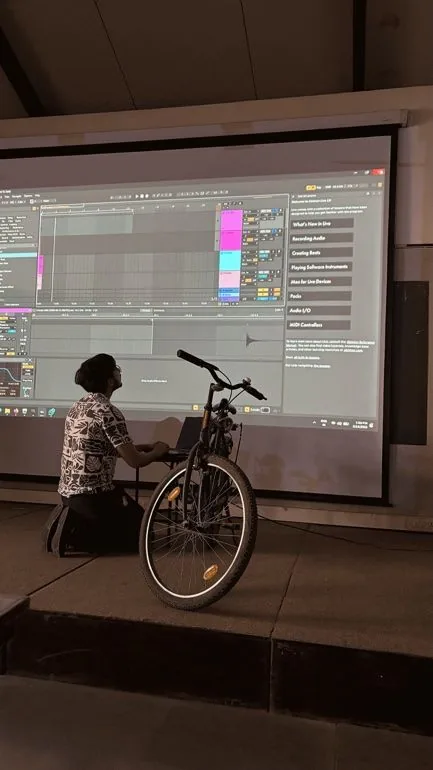
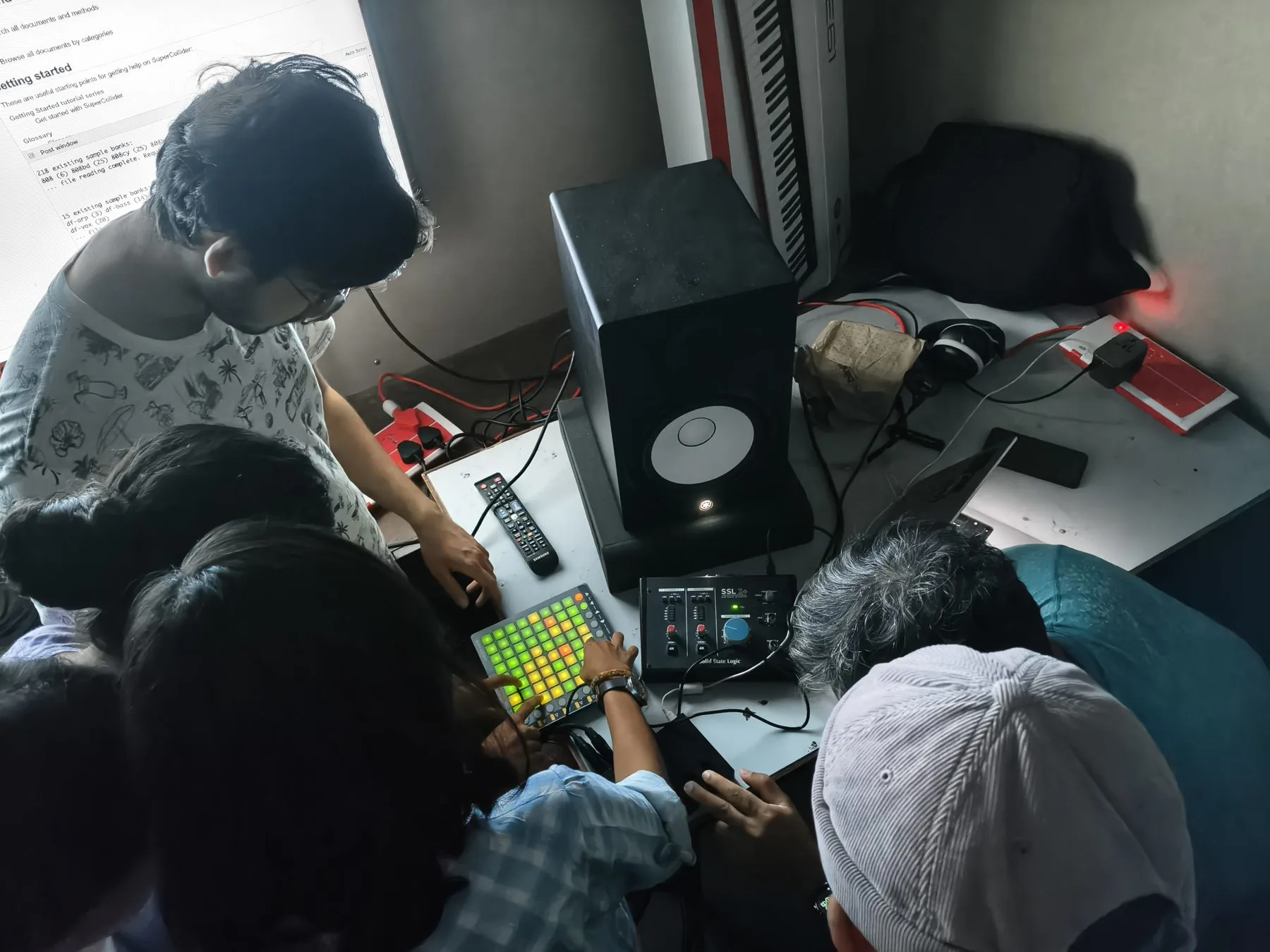
Full semester or 1-month moduleWriting sound and image as code and performing it in front of an audience. Pattern, algorithm and generative systems, ending in a live performance open to the campus. Led by Abhinay Khoparzi of Algorave India.
TidalCycles · Strudel · SuperCollider · p5.js · Generative systems
Physical Computing and Instrument Building
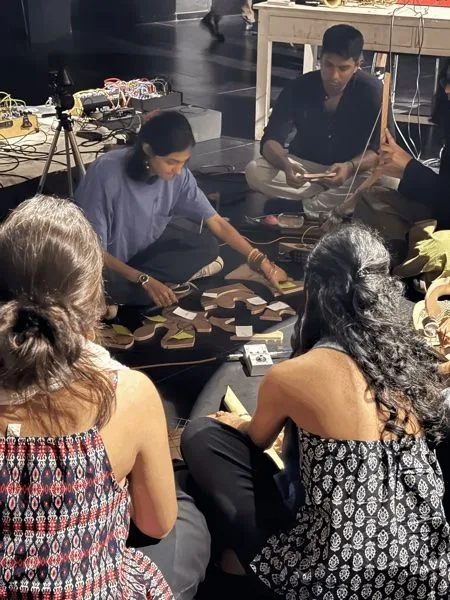
1-month module or intensiveBuilding original instruments from found, junk and natural materials, and from first principles: piezo microphone and hydrophone fabrication and soldering, bamboo and wood assemblies, embedded programming and web audio. Physical making as sonic thinking.
Arduino · MicroPython · Piezo and hydrophone fabrication · Web MIDI and Tone.js · Max for Live
Machine Learning as Expressive Material
1-month modulePose, gesture and sound recognition used for perception and accessibility rather than benchmark accuracy. Students develop a taxonomy, train or adapt a model, and build something a person can actually stand in front of.
MoveNet · MediaPipe · Kinect · Gesture mapping · Accessibility design
Real-Time Graphics and Projection Mapping
1-month moduleCalibrating projection onto curved, suspended and sculpted geometry, and building generative content that responds to sound and sensor input in real time.
TouchDesigner · camSchnappr · Photogrammetry · Sensor input · DMX basics
Acoustics, Psychoacoustics and Spatial Audio
Full semester or moduleWhere signal processing meets perception. Frequency, amplitude and timbre against what a listener actually experiences, then stereo, binaural and ambisonic composition for a specific space.
Psychoacoustics · Ambisonics · Binaural · Room and site acoustics · Multichannel systems
Sound Studies and Critical Listening
Seminar, pairs with any of the aboveThe reading strand: acoustic ecology, sound studies, South Asian material, and the politics of who gets to be heard. Designed to satisfy a humanities or liberal arts credit while staying attached to a studio.
Acoustic ecology · Sound studies · Practice-based research methods · Critical writing
IP, Authorship and the Creative Economy
1 weekCopyright, moral rights, licensing, and AI and authorship, from the practitioner’s perspective. Increasingly the most consequential subject on a technology campus and almost never taught from the maker’s side.
IP for technologists · AI and authorship · Licensing strategy · Creative economy
Where it fits on your campus
HSS and liberal arts electives
A credited elective that is genuinely a studio, satisfying the interdisciplinary requirement without becoming a checkbox.
Design and new media programmes
A sustained studio strand alongside existing HCI, interaction and product courses.
Maker space and tinkering lab
An intensive that gives the fabrication facility a reason to be used for something other than a prototype demo.
Festivals and residencies
A live coding concert, an immersive installation, or a resident ensemble, as the public face of the engagement.
The next step is a thirty-minute call.
Which cohort, which semester, how much studio time you can protect, and what you want them to have made by the end of it. We come back with a course outline written for your credit structure.
+91 73887 28268